Cost
What metal roof repair costs in Phoenix, and what changes the price
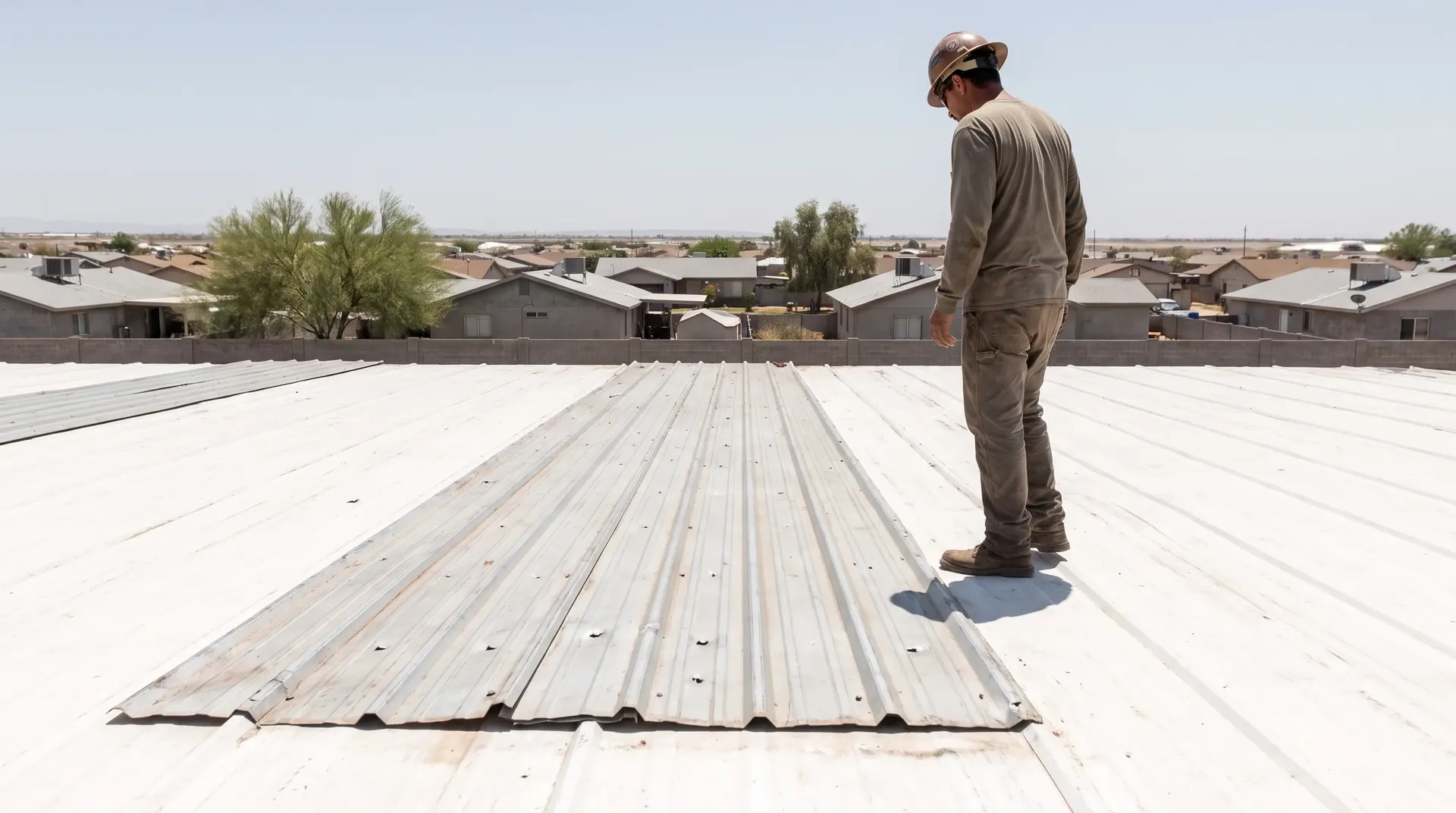
Nobody can tell you what your metal roof repair will cost without going up and looking at it, and anyone who gives you a confident figure over the phone is guessing at your expense. That is an unsatisfying answer to the question you actually asked, so here is the useful version instead: everything that genuinely moves the number, roughly in order of how much it moves it.
If you know which of these apply to your roof, you will have a fairly good sense of whether you are looking at a small job or a large one before anybody arrives.
How much of the roof is involved
This is the biggest single factor and it is usually the one homeowners underestimate.
Three failed fasteners and one open seam is a small, contained job. The problem is that fasteners and sealant on a roof were nearly always installed at the same time, in the same conditions, and have had the same number of summers. So when we find three that have failed, we very often find that most of the rest are close behind.
That produces a genuine decision. You can repair the three that are leaking, which is cheap today and likely to bring us back next year. Or you can refasten the run while somebody is already up there, which costs more now and much less over the next five years. Neither answer is wrong. But it is the difference between a small invoice and a medium one, and it is worth understanding before you are surprised by it.
How hard the roof is to get onto and work on
Access changes the labour on every job.
A single storey patio cover you can reach off a short ladder is straightforward. A two storey roof, a roof with no clear ladder position, a roof with equipment crowded across it, or a roof steep enough to need fall protection, all take longer for the same amount of actual repair. Solar arrays are a particular case, because they restrict access to whatever is underneath them and they are not ours to move.
Pitch and how water behaves
A low slope roof is easier to walk and harder to keep dry. Water moves off a pitched roof immediately, and lingers on a low slope one, which means details have to be better and repairs have to be more thorough to last. The very low slope roofs common on Valley carports, Arizona rooms and park models often need a more robust solution than a steeper roof would, and that is reflected in the cost.
The panel profile, and whether it still exists
Matching matters, and matching is not always possible.
Common corrugated and R panel profiles are readily available. Older or proprietary profiles sometimes are not, and a discontinued panel can mean either sourcing a match with some effort or accepting a visible difference. On a roof nobody sees, that is a conversation about money. On a visible roof plane it is a conversation about appearance too, and both take time to resolve.
How long it has been leaking
This is the factor that turns cheap jobs into expensive ones, and it is entirely within a homeowner’s control.
A fastener that started leaking in July and is looked at in August has wet a small area of purlin. The same fastener left for three seasons has been soaking the same timber every monsoon, and softened timber will not hold a fastener, which means the repair is no longer just a repair. Now there is structure to deal with before anything can go back on top of it.
Water that has got past the roof and into a ceiling or a wall is a different order of problem again, and at that point the roof is the cheap part.
What else is found while somebody is up there
Almost every roof produces something unexpected. A pipe boot that has split. A length of trim with two fasteners left in it. A cooler bleed line discharging onto a panel. None of those are the reason we were called, and all of them are cheap to deal with in the same visit and expensive to deal with as a separate one.
We tell you what we find and separate it into what needs doing and what can wait. You decide.
When it is worth getting somebody out
Call when you see water inside, obviously. But the cheaper time to call is before that: when screw heads look uneven along a run, when sealant in the laps has gone hard and cracked, when trim has lifted at one end, or when a rust streak has appeared below something on the roof.
The other good time is any point between about October and April. Not because the work is different, but because on a Valley metal roof in summer, careful work has to happen before mid morning, which limits what can be done in a visit. Winter and spring are simply easier, and things found then get fixed calmly.
Common questions
How much on average does it cost to fix a leaking roof?
Averages are close to meaningless here, because the range runs from a handful of fasteners on an accessible patio cover to a full refasten with structural repair on a large low slope roof. What determines your number is the list above, not a regional average. We give you a figure after we have been up there.
What's the average cost to patch a roof?
On a metal roof, a proper repair is usually replacing a component rather than patching over one, which is a different job from what the word patch suggests. Swapping a single panel on an accessible roof is a small job. What makes it larger is access, profile availability and whatever the water reached before anybody looked.
Can you patch my roof myself?
You can, and consumer tapes and sealants will stop water temporarily. The two problems are that a repair applied over an undiagnosed defect hides it rather than fixing it, and that a metal roof in this climate is genuinely dangerous to be on. If you are going to do anything yourself, do it from a ladder at the edge and not from the middle of the roof in July.
What if I can't afford to replace my roof?
That is very often the right conversation to be having, because a great many roofs that have been quoted for replacement do not need replacing. If somebody has told you yours is finished, it is worth having it looked at by somebody who does not sell new roofs before you accept that.