Service
Metal roof leak repair
The stain on your ceiling is where the water came out. It is very rarely where it went in. We find where it went in.
Every entry point, not just the first one
Metal Roof Leak Repair
Water travels a long way before it drips
This is the thing that makes metal roof leaks so frustrating to chase. Water gets in through a hole the size of a screw thread, runs down the underside of the panel, tracks sideways along a purlin, and then falls off wherever the timber happens to stop. By the time it hits your ceiling it can be a long way from where it started, and it is nearly always uphill of the stain.
So the worst way to fix a metal roof leak is to go up, look at the area above the wet patch, find something that looks wrong, seal it and leave. Sometimes that works. More often the roof leaks again in the next storm, because the thing that was actually letting water in was six feet further up the slope.
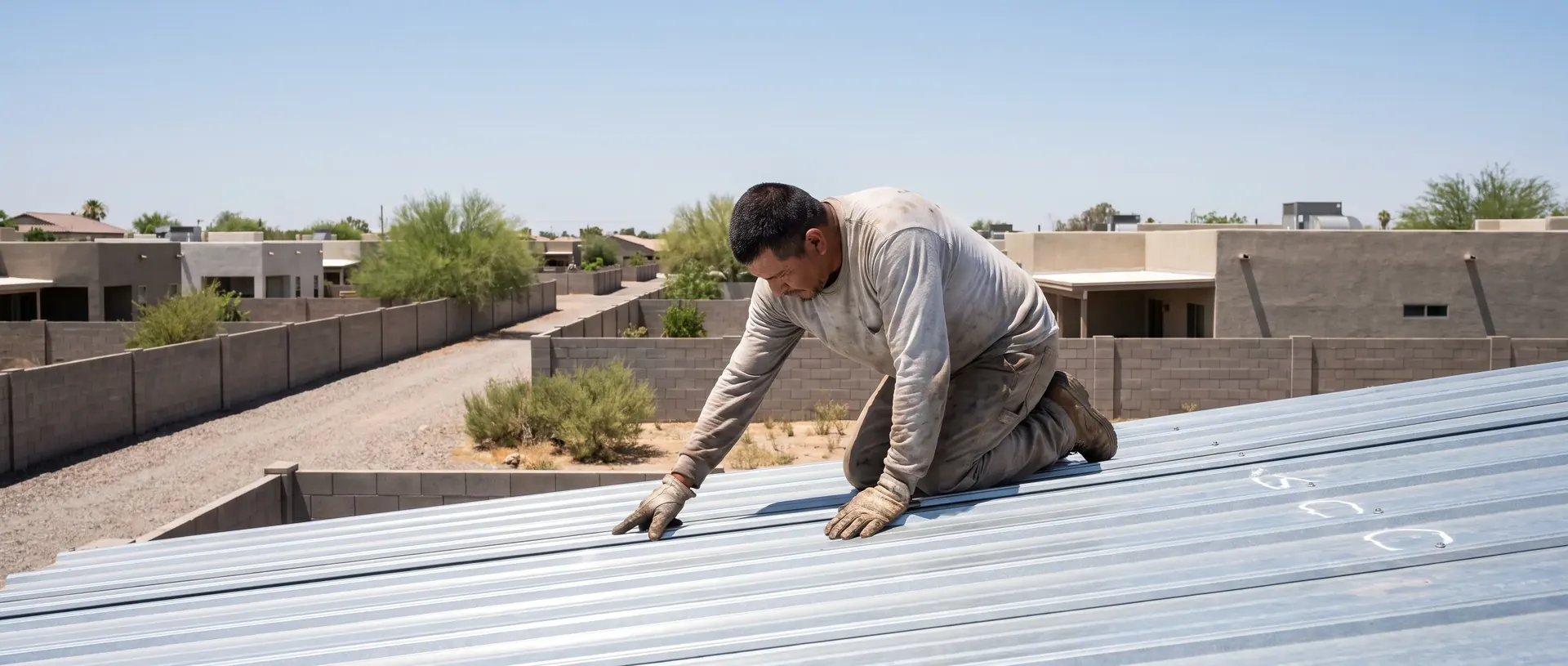
We work it the other way around. We start from where the water is showing, get underneath if there is any way to get underneath, and follow the track back up until we find the entry point. Then we keep looking, because a roof that has one failed fastener at ten years old usually has several more about to go.
Where Valley leaks actually start
Fasteners
On an exposed fastener roof this is the leading cause by a wide margin. Every screw is a hole in the roof sealed by a small rubber washer, and Arizona sun destroys that washer long before anything happens to the panel. Add daily thermal movement backing the screw out, and the hole stops being sealed at all.
Laps and seams
Where two panels overlap, side to side or end to end, there is sealant or butyl tape doing the work. That material has a service life measured in years here, not decades. When it hardens and shrinks, the lap opens, and wind driven rain in a monsoon pushes water uphill into the gap.
Penetrations and transitions
Pipe boots, vents, skylights, evaporative cooler curbs, solar mounting feet, and every point where the roof meets a wall. These are holes and joints somebody made on purpose, and they leak for the same reason everything else does: the sealant around them gave up.
What we do when we come out
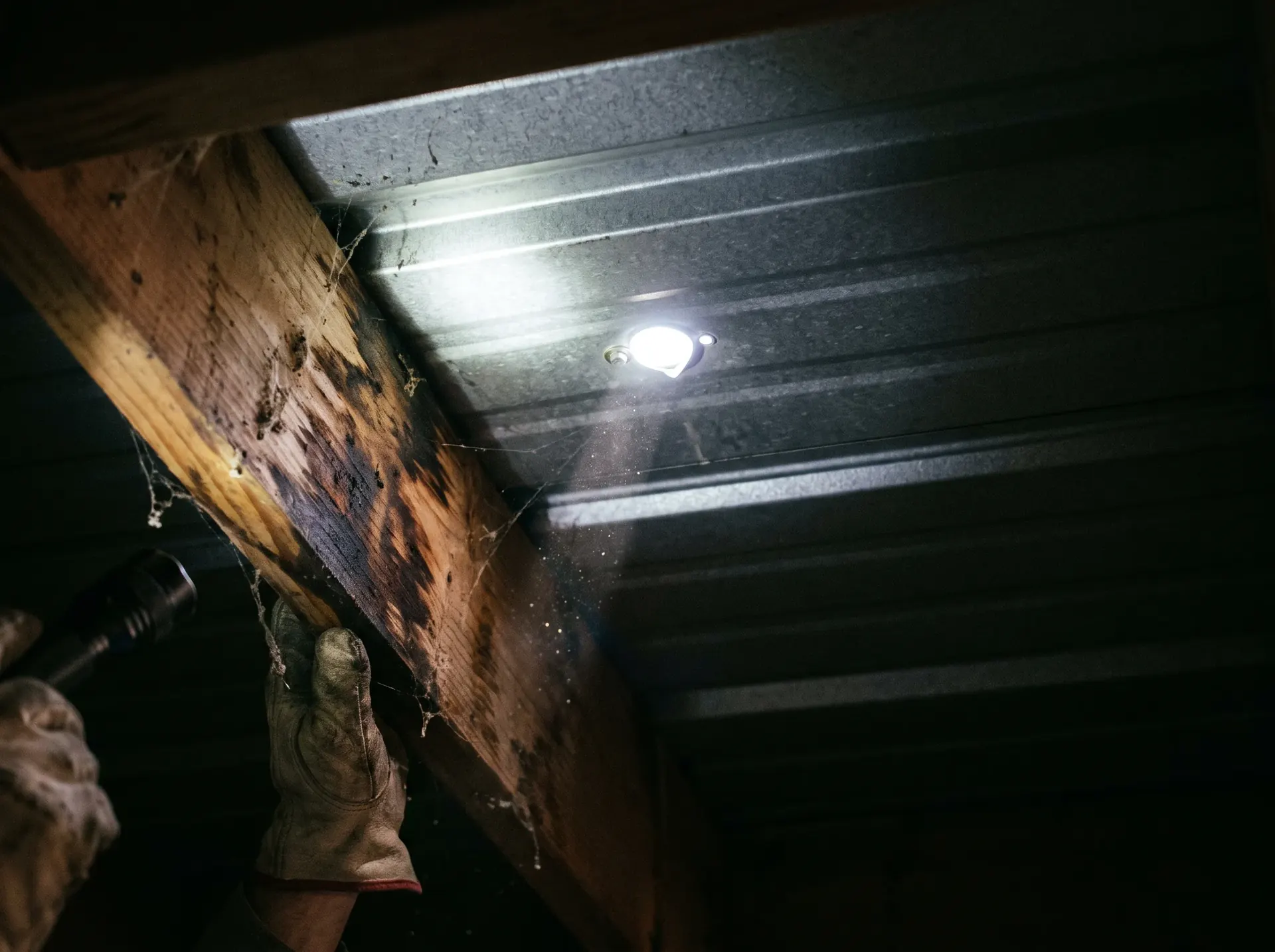
We look from inside first
If there is an accessible attic, patio roof cavity or open ceiling structure, we start there. Staining on the purlins and rafters shows the path the water took, and that path points uphill to the entry.
We go over the whole roof
Every fastener line, every lap, every penetration, every wall transition. Not only the section above the stain. We chalk each defect as we find it so nothing gets lost.
We photograph everything
Each defect gets photographed where it sits. You get those pictures whether or not you have us do the work.
We tell you what is urgent and what is not
There is usually a difference between what is letting water in today and what will be letting water in next August. You get told which is which, and you decide.
Process
How we track a leak down
What it does and when
Whether it drips in any rain or only in a hard blow tells us a lot. A leak that only shows in a monsoon usually means wind driven water is being pushed into a lap or up under trim.
Inside, following the stain
We look for the track rather than the drip. Water marks along a purlin run in a direction, and that direction is the clue.
Uphill on the roof
We work up the slope from the point the track suggests, checking fasteners, laps and any penetration in that run.
Water testing
Where the source is not obvious, we run water on the roof in sections, starting low and working up, with somebody watching underneath.
The repair
Fasteners replaced, laps opened and resealed properly rather than smeared over, flashing reworked, boots and curbs redone. Whatever the actual defect turns out to be.
Test it again
Water back on the same area, checked from below. A repair that has not been tested is a guess.
Why this goes better with us
We have no reason to condemn your roof
We do not install metal roofs, so a replacement is not a sale for us. If the roof is repairable we will repair it. If it genuinely is not, we will tell you that and hand you the photographs to take to whoever quotes the replacement.
We do not just seal what we can see
Smearing sealant over a suspicious looking screw is the fastest way to make a leak stop for one season and come back worse. Where a fastener has spun out its hole, it needs a larger fastener biting fresh material, not a lid of caulk.
We know what survives an Arizona summer
Sealants and tapes behave very differently at a hundred and fifteen degrees on a metal surface than they do in a catalogue. Choosing material that will still be flexible in three summers is most of the skill.
You keep the evidence
The photographs are yours. So is the plain language explanation of what is wrong. If you want another opinion, you are equipped to go and get one.
Got a stain on the ceiling
Tell us where it is and when it started, and send a photo if you can.
Reviews
What our customers say
We have not collected any reviews yet. When we do they will appear here in full.
Common questions about metal roof leaks
Can metal roof leaks be repaired?
Almost always. The parts of a metal roof that leak are fasteners, sealant, laps, flashing, boots and trim, and every one of those is a replaceable component. The panel itself is usually the last thing to fail. A roof only stops being repairable when the metal has corroded through over a wide area or the structure holding it up has gone.
What is the most common cause of metal roof leaks?
On an exposed fastener roof, the fasteners. There are thousands of them, each sealing a hole with a rubber washer that Arizona sun degrades from the day it goes on. Once the washer perishes and the screw backs out slightly, the hole is open. On a standing seam roof it is more often the penetrations and the flashing at wall transitions.
Why does my metal roof leak during heavy rain?
Because wind driven water behaves differently from water falling straight down. In a monsoon, rain hits the roof at an angle and gets pushed uphill into laps, under trim and behind flashing that copes perfectly well with ordinary rain. A roof that only leaks in a hard blow usually has an open lap or a lifted piece of trim rather than a hole.
How do I find where my metal roof is leaking?
Start inside if you safely can, and look for staining along the timbers rather than directly above the drip. Water runs along a purlin before it falls. Outside, check the fasteners first, then the end laps, then anything penetrating the roof, then the wall transitions. If you cannot see all of that safely from a ladder, do not go up on a metal roof in summer to look.
How do you seal a leaking metal roof?
It depends entirely on what is leaking, which is why the diagnosis matters more than the sealant. A failed fastener needs a new oversized fastener, not sealant. An open end lap needs opening up, cleaning out and rebedding. A perished pipe boot needs replacing. Sealant applied over an unresolved defect is a delay, not a repair.
Is it common for metal roofs to leak?
Common enough that it is normal maintenance rather than a fault. A metal roof in this climate will need its fasteners looked at and its laps and penetrations reworked periodically across its life. That is expected, and it is a great deal cheaper than the alternative, which is why these roofs last as long as they do.
Get a quote
Tell us what the roof is doing
Where the water shows up, when it started, and whether it only happens in a hard blow.
- Call
- (602) 555-0143
- Hours
- Mon to Sat, 6am to 5pm