Diagnosis
Where metal roofs leak first in Arizona, and why
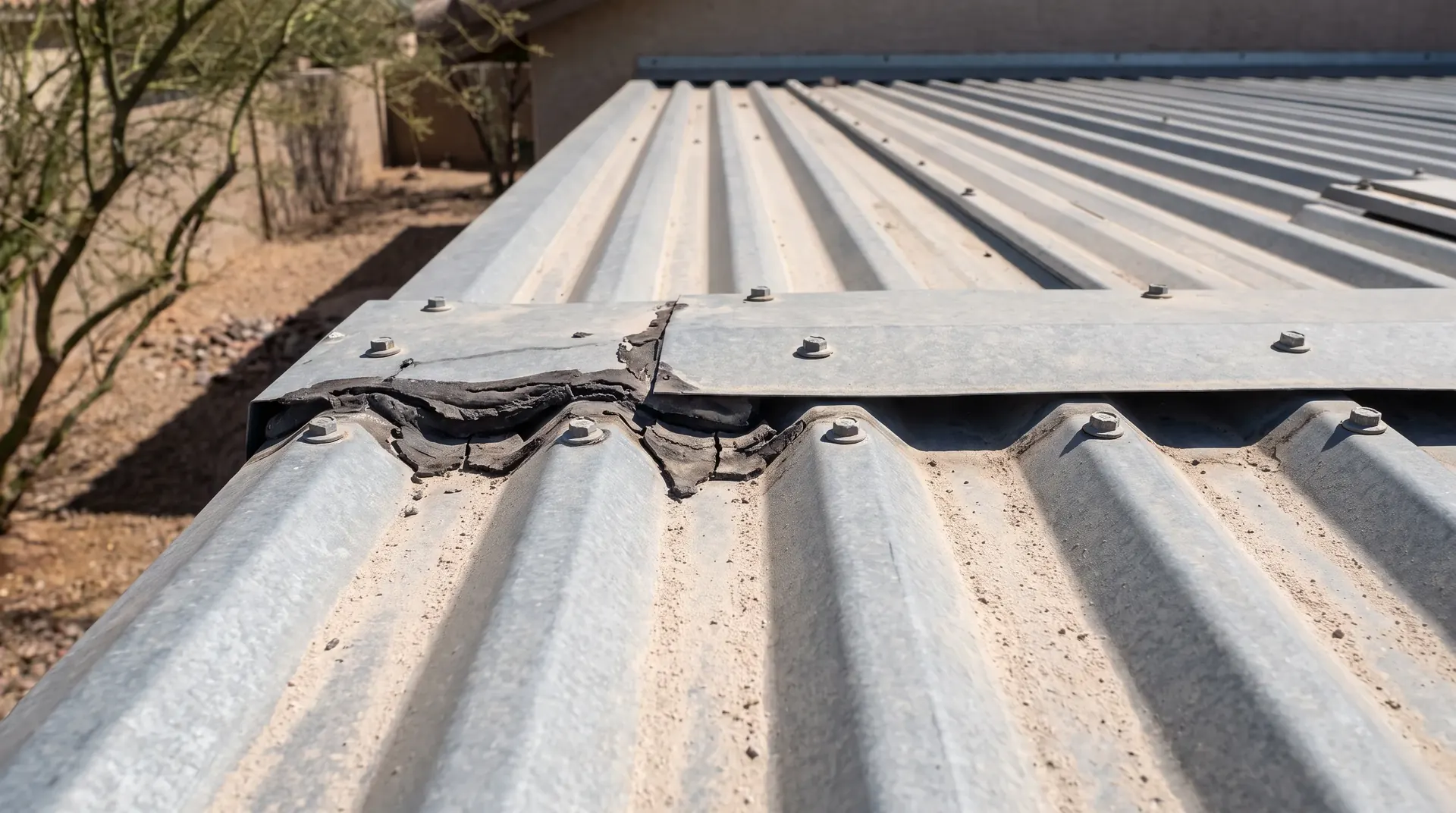
Metal roofs in this climate leak in a predictable order, and the panel is almost always last. Understanding that order is genuinely useful, because it tells you where to look, it tells you whether a quote makes sense, and it explains why a roof that looks perfect from the driveway can be letting water into your ceiling.
The order is fasteners, then end laps, then penetrations, then wall transitions. Here is why each one fails, and why the metal itself outlives all of them.
1. The fasteners
On an exposed fastener roof this is the leading cause by a wide margin, and it is not close.
Every screw holding your roof down is a deliberate hole through the panel, sealed by a small neoprene washer squeezed under the head. There can be several thousand of them on one roof. Arizona sun hardens and cracks that neoprene, and daily thermal movement slowly walks the screw itself up out of the purlin. Either failure on its own opens the hole.
A roof can have entirely sound panels and still be leaking in a dozen places because of this. It is also why the leak is so often nowhere near the stain: water enters at a screw, runs down the underside of the panel, tracks along a purlin and drips somewhere else entirely.
2. The end laps
Where two panels overlap end to end, running up the slope, there is sealant or butyl tape doing the sealing.
End laps are harder than side laps because water has to be persuaded to keep travelling downhill across a joint, and wind can push it back the other way. When the sealant in that lap hardens and shrinks, which in this climate happens on a timescale of years rather than decades, the joint opens.
This is the classic cause of a roof that only leaks in a monsoon and never in ordinary rain. Vertical rain runs across the lap without difficulty. Wind driven rain gets pushed uphill into it.
3. The penetrations
Everything anybody has ever put through the roof. Pipe boots, vents, skylights, evaporative cooler curbs and solar mounting feet.
Rubber pipe boots are particularly short lived here, because they are thin flexible rubber sitting in full sun, and they split. Solar mounting feet are a growing share of what we see, because array installation puts new holes through roofs that were previously watertight, and the sealing detail is often not the installer’s strongest area.
4. The wall transitions
Where a roof plane runs into a vertical wall. In metro Phoenix that most often means the junction where a patio cover, carport or Arizona room meets the house.
Done properly, the flashing turns up behind the wall finish so water cannot get behind it. Done the quick way, it is stuck to the face of the stucco and sealed, and that joint is on a clock from the day it is made. Since most of these structures were added later by somebody who was not a roofer, the quick way is very common.
Last: the panels
The metal itself is generally the most durable part of the roof and the last thing to fail, which is exactly why so many metal roofs are worth repairing rather than replacing.
When panels do fail here, it is usually not from weather. It is impact damage from monsoon debris, or corrosion under a persistent water source such as a cooler bleed line, which is a localised problem rather than a whole roof one.
The sun gets the sealant first
In a wet climate, the enemy is water and everything ages roughly together. Here it is ultraviolet light and heat, and those attack a specific set of materials.
Neoprene washers, butyl tape, sealants, rubber boots and coatings are all polymers, and polymers degrade under ultraviolet exposure and high temperature. The steel or aluminium panel does not care. So the roof ages unevenly, with every soft component reaching the end of its life while the hard components are barely started.
That is the whole explanation for why this order holds so reliably in Arizona, and it is also the good news. Every item on the list is a replaceable consumable rather than a structural failure.
What the pattern tells you
If it leaks in any rain, look for an open hole, which usually means a fastener or a split boot.
If it only leaks when the wind is behind the storm, look for an open joint, which usually means an end lap or lifted trim.
If it leaks near where the patio cover meets the house, it is almost certainly the wall transition.
And if a roofing company has told you a roof in this order of failure needs replacing, it is worth getting a second look from somebody who does not sell new roofs.
Common questions
What is the most common cause of metal roof leaks?
On an exposed fastener roof, the fasteners, because each one is a hole sealed by a washer that the sun is actively degrading. On a standing seam roof, which has no exposed fasteners, it is penetrations and flashing at wall transitions instead.
Why does my metal roof leak during heavy rain?
Because monsoon rain arrives at an angle and gets driven uphill into laps and behind trim that handle vertical rain perfectly well. A roof that leaks only in a hard blow usually has an open joint rather than a hole.
How to find where a metal roof is leaking?
Start inside and look for staining along the purlins and rafters rather than directly above the drip, because water runs sideways before it falls, and the track points uphill towards the entry. Outside, work through the order above. If you cannot see it all safely from a ladder at the edge, do not go up.
Is it common for metal roofs to leak?
Common enough to be normal maintenance rather than a fault. Every metal roof in this climate will eventually need its fasteners, sealants and boots attended to, because those are consumable parts. That is not the roof failing. It is the roof reaching a scheduled service.