Service
Fastener and screw replacement
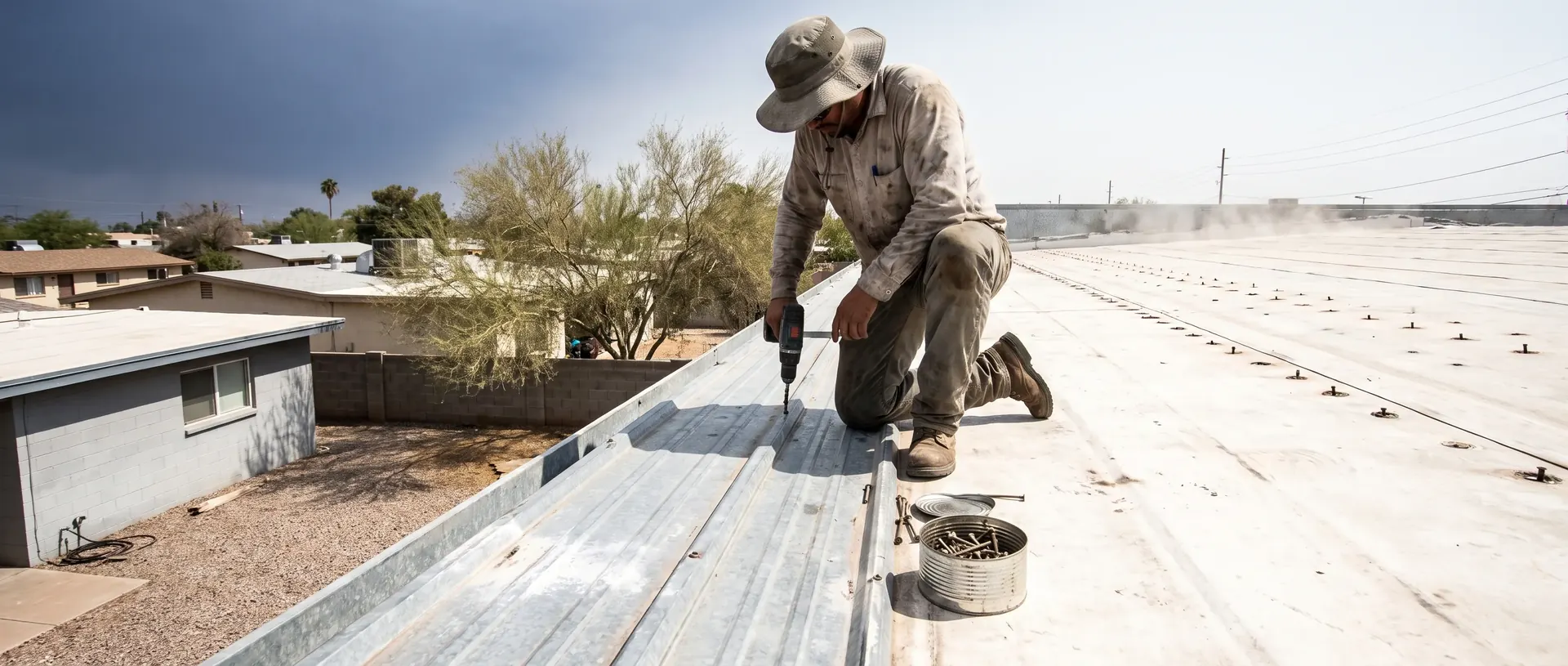
Thousands of small holes in your roof, each one sealed by a rubber washer that Arizona sun is working on every day.
The most common repair we do
Fastener and Screw Replacement
Why screws back out of roofs here and not everywhere
An exposed fastener metal roof is held down by screws driven through the flat of the panel into the purlin below, each one sealed by a small neoprene washer squashed under the screw head. It is a good system. It has one weakness, and metro Phoenix attacks that weakness harder than almost anywhere.
Metal expands when it gets hot and contracts when it cools. On a summer day here, a panel can go from an overnight low in the eighties to a surface temperature far above the air temperature by mid afternoon, and a long panel moves a genuinely surprising distance along its length as that happens. It does that today, tomorrow, and every day from May through September.
The screw does not move. The panel does, sliding a fraction of a millimetre back and forth against the shank thousands of times a season. That slow working action is what walks a fastener up out of the timber. Meanwhile the sun is doing its other job on the neoprene washer, hardening it, cracking it and squeezing it flat until it is no longer sealing anything.
Put those together and you get the single most common metal roof failure in the Valley: a line of screws standing slightly proud, several with perished washers, and a roof that starts leaking in the first serious monsoon of the year.
What goes wrong at the fastener
Backed out screws
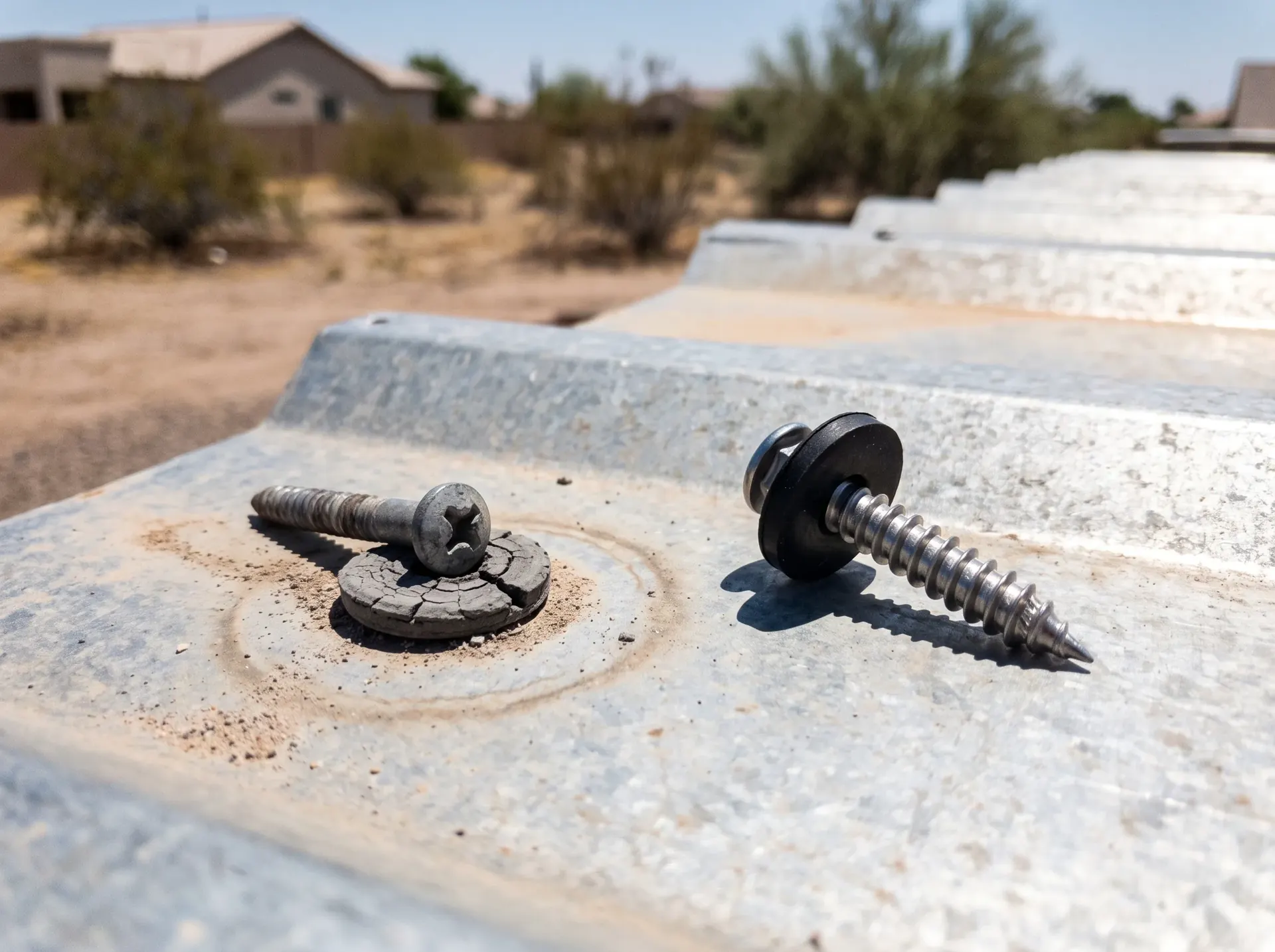
The screw head sits proud of the panel, so the washer is no longer compressed and no longer sealing. Sometimes you can see this from the ground as an uneven line of heads catching the light. Driving them back down is not the answer, because the threads in the timber are already chewed.
Perished washers
The neoprene has gone hard, cracked around its edge or squeezed out flat from being overdriven when it was installed. The screw may be perfectly tight and the hole still open, which is why a tight looking roof can leak.
Spun out holes
The screw turns and never bites, because the hole in the purlin has been enlarged by movement or by repeated refastening. A screw of the same size will never hold here. It needs a larger diameter fastener reaching fresh material.
What we do when we come out
We check the whole fastener population
Not a sample. Fasteners fail in patterns, usually worst on the sunniest slope and along the panel ends, and you only see the pattern by going over all of them.
We separate the failures from the survivors
There is no value in replacing a screw that is properly seated with an intact washer. We identify what has actually gone and price that, not the whole roof by default.
We size the replacements to the holes
Where the original hole is sound, a like for like fastener goes back. Where it has spun out, the replacement steps up in diameter so it bites into material that has not been damaged.
We photograph everything
Each defect gets photographed where it sits. You get those pictures whether or not you have us do the work.
Process
How a refastening goes
Survey the runs
Every fastener line walked and assessed, with the failures marked as we go so nothing is missed later.
Decide spot repair or full refasten
A handful of failures in one area is a spot repair. A roof where most washers have gone is a full refasten, and doing that in one go is far cheaper than returning four times.
Remove the failed fasteners
Backed out and spun screws come out. We keep them, because a tin of old fixings is the clearest possible explanation of what we found.
Assess each hole
Sound holes take a matching fastener. Enlarged holes take an oversized one. Holes in timber that has gone soft need the substrate dealt with first.
Drive to the correct compression
This is where most refastening jobs are won or lost. The washer needs to be compressed enough to seal and not so much that it extrudes out from under the head and splits. It is set by feel and by looking, not by running an impact driver at full speed.
Check the run and clean up
The whole line looked over for consistent height and compression, then every old screw and swarf cleared off the roof and out of the gravel below.
Why this goes better with us
We do not just drive them back down
Retightening a backed out screw into a chewed hole feels like a fix for about a season. The threads are already gone, and the panel movement that pushed it out the first time is still there.
We get the compression right
Overdriving is the most common installation error we find, and it destroys the washer immediately. A roof refastened too hard leaks sooner than one that was left alone.
We treat it as maintenance, not as a fault
Fasteners are consumable on a roof in this climate. Needing them replaced does not mean your roof was built wrong or is failing, and anybody telling you it does is selling something.
You keep the evidence
The photographs are yours, and so is the tin of old fasteners if you want it. It makes the conversation about what was actually wrong very short.
Seeing screw heads standing proud
If the line of heads along your roof looks uneven from the ground, it is worth a look before monsoon season.
Reviews
What our customers say
We have not collected any reviews yet. When we do they will appear here in full.
Common questions about roofing screws
Why are the screws backing out on my metal roof?
Daily thermal movement. The panel expands and contracts every day through a Valley summer, sliding slightly against the shank of a screw that is anchored in the timber. That repeated working action gradually walks the fastener up out of the purlin. Long panels and sun facing slopes go first.
Is it common for screws to back out of a metal roof?
Very, in this climate. It is one of the most predictable things a metal roof does here, and it is the reason periodic refastening is normal maintenance rather than a sign of a defect. In milder climates with less extreme daily swings it happens much more slowly.
Do metal roofs leak at the screws?
It is the leading cause of leaks on an exposed fastener roof. Each screw is a deliberate hole through the panel, sealed only by the washer under its head. When that washer perishes or the screw stands proud, the hole is unsealed. There can be several thousand of them on one roof.
How often should you replace screws on a metal roof?
There is no fixed interval that means anything, because it depends on the exposure, the panel length, the original installation quality and how hard the sun hits that particular slope. The practical answer is to have them looked at when you first see heads standing proud or washers cracking, and before monsoon season rather than during it.
How much does it cost to replace all the screws on a metal roof?
It scales with the number of fasteners, which is a function of roof area and panel layout, plus how difficult the roof is to work on. A full refasten of a large roof is a real job. A spot repair on one bad run is not. We count and price after looking, never over the phone.
Should metal roof screws go in flat or ridge?
Both are used and it depends on the panel system and the manufacturer detail for it. Fastening through the flat is the more common arrangement on the screw down panels typical across the Valley. What matters far more than the debate is that the fastener is the right length, driven to the right compression and hitting solid timber.
Get a quote
Tell us what the roof is doing
If you can get a photo along the line of screw heads, that tells us a lot.
- Call
- (602) 555-0143
- Hours
- Mon to Sat, 6am to 5pm