Maintenance
Why metal roof screws back out in Phoenix heat
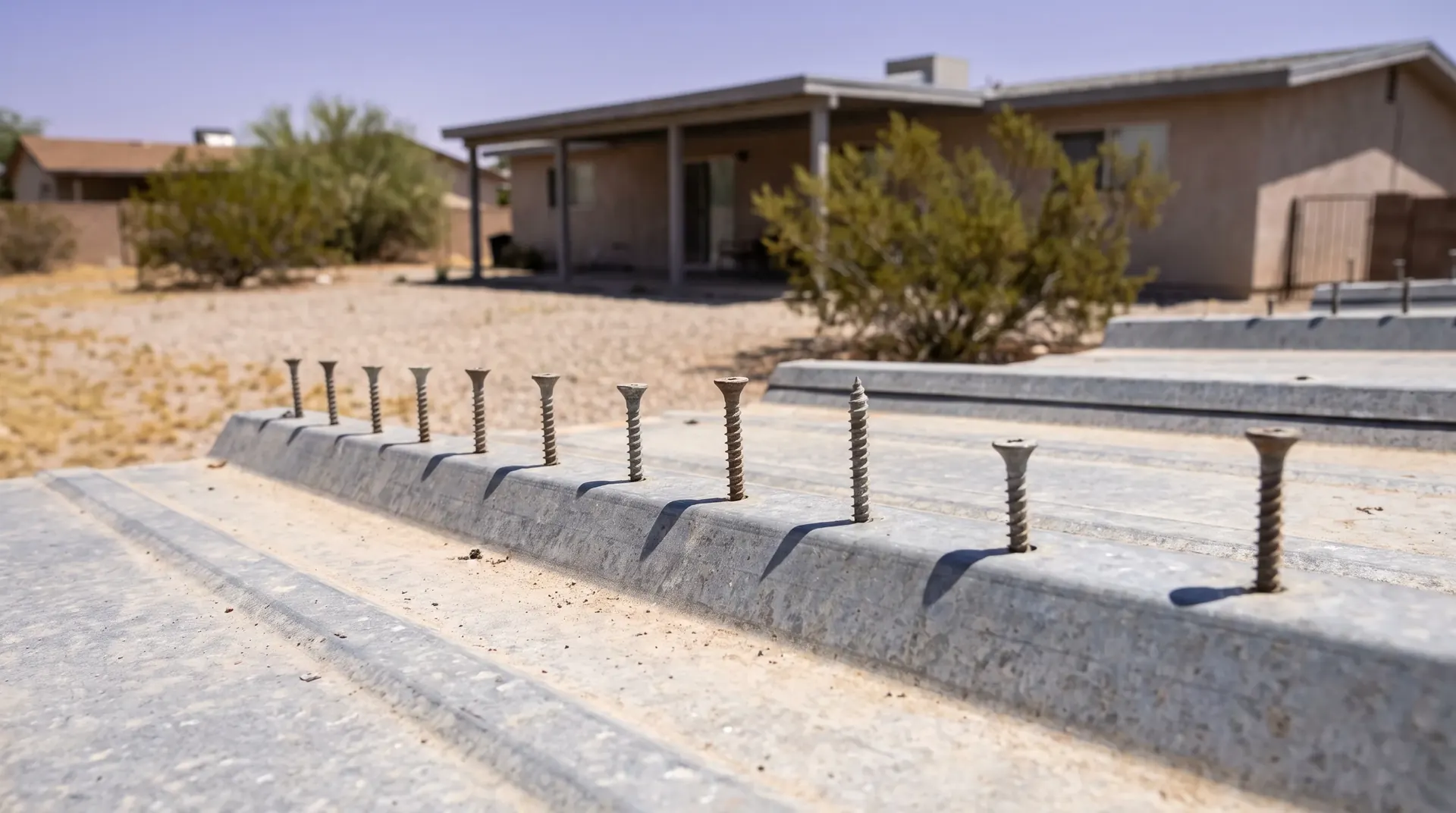
If the line of screw heads along your roof has started to look uneven, with some standing slightly proud of the panel, your roof is doing something completely normal for a metal roof in metro Phoenix. It is not a sign that it was installed badly and it is not a sign that the roof is failing. It is thermal cycling, and this is close to the worst place in the country for it.
Here is what is actually happening up there, and what to do about it.
Your roof is a different size in the afternoon than it was at dawn
Metal expands when it is heated and contracts when it cools. That is not a defect, it is a property, and every metal roof ever built is designed with it in mind.
The scale of it here is the problem. A metal panel in direct Valley sun reaches a surface temperature well above the air temperature, so a roof that started the night in the eighties can be far hotter than the forecast high by the middle of the afternoon. A long panel expands measurably along its length across that swing, then contracts again overnight. Then it does it again. And again, every day, from roughly May through September.
The panel moves, the screw does not
The screw is anchored in the purlin below. The panel is sliding back and forth against it, a fraction of a millimetre at a time, thousands of times a season.
That is a working action, and working actions loosen threaded fasteners. It is the same reason a bolt on a vibrating machine backs out. Each cycle rotates or lifts the screw an imperceptible amount, and imperceptible amounts add up over several hundred cycles a year.
The longer the panel run, the more total movement there is at the ends, which is why fasteners near the ends of long runs typically go first. Sun facing slopes go before shaded ones. Roofs with no shade at any point in the day go before roofs with some.
Meanwhile the sun is destroying the washer
Each roofing screw seals its hole with a small neoprene washer compressed under the head. That washer is the only thing standing between a hole in your roof and the inside of your building.
Ultraviolet light and heat harden neoprene, then crack it, then break it down. In this climate that process runs considerably faster than the marketing life of the fastener suggests, and it happens on a completely separate schedule from the backing out. Which means a roof can have screws that are still perfectly tight and washers that have entirely given up, and that roof will leak while looking fine from the ground.
Then the hole gives up too
Every cycle of movement also works the hole itself. Over enough time, the hole in the purlin enlarges, and eventually a screw driven into it will simply spin without biting. At that point putting the same screw back is pointless, and putting a slightly longer one in does not help either, because the diameter is the problem, not the depth.
Do not just drive them back down
This is the obvious move and it is the wrong one. The threads in the timber are already damaged, the washer has already perished, and the movement that pushed the screw out is still happening. Driving it back down produces a roof that looks correct for a season.
What a proper refastening involves
The failed fasteners come out. Each hole gets assessed. Sound holes take a matching replacement fastener. Enlarged and spun holes take an oversized one that bites into material the old screw never reached. Where the timber underneath has gone soft from repeated wetting, that gets dealt with before anything goes back in.
Then the important part: each fastener is driven to the correct compression. Enough to squash the washer into a seal, not so much that it extrudes out from under the head and splits. Overdriving is the single most common installation error we find, and a roof refastened too hard leaks sooner than one nobody touched.
Spot repair or the whole run
If a handful have failed in one area, a spot repair is sensible. If most of the washers on a roof have gone, doing the whole run in one visit costs considerably less than four separate visits over the next three years, and it resets the clock on the entire roof at once.
We count what has actually failed and tell you which situation you are in. Not every roof with a backed out screw needs a full refasten.
What to look for from the ground
Stand back and look along the fastener lines rather than at them. A healthy run reads as a straight even line of heads. A run that needs attention looks uneven, with individual heads catching the light differently because they are sitting at different heights.
Also look at the washers if you can get close from a ladder at the edge. Cracked, flattened or squeezed out neoprene means that fastener is no longer sealing regardless of how tight it feels.
The best time to deal with any of this is between October and April, before the season that causes it starts again.
Common questions
What causes screws to back out?
Repeated movement between the fastened parts. On a roof, that movement is thermal expansion and contraction of the panel against a screw held in the structure below. Each cycle works the fastener a tiny amount, and the cycles accumulate over a summer.
How to keep screws from backing out of metal?
On a roof, the practical answers are correct initial fastener selection, correct driving compression, and accepting that exposed fastener roofs in this climate need periodic refastening as maintenance. Where a roof is going to be refastened anyway, moving up a fastener size into fresh material gives a considerably longer service life than replacing like for like into a tired hole.
Is it common for screws to back out of a metal roof?
In metro Phoenix, extremely. It is one of the most predictable things a metal roof does here. In milder climates with smaller daily temperature swings the same roof would take much longer to reach the same state.
Do metal roofs leak at the screws?
It is the leading cause of leaks on an exposed fastener roof, because every screw is a deliberate hole sealed only by a washer. A large roof can have several thousand of them, so it only takes a small failure rate to produce a leak.