Service
Rust and corrosion repair
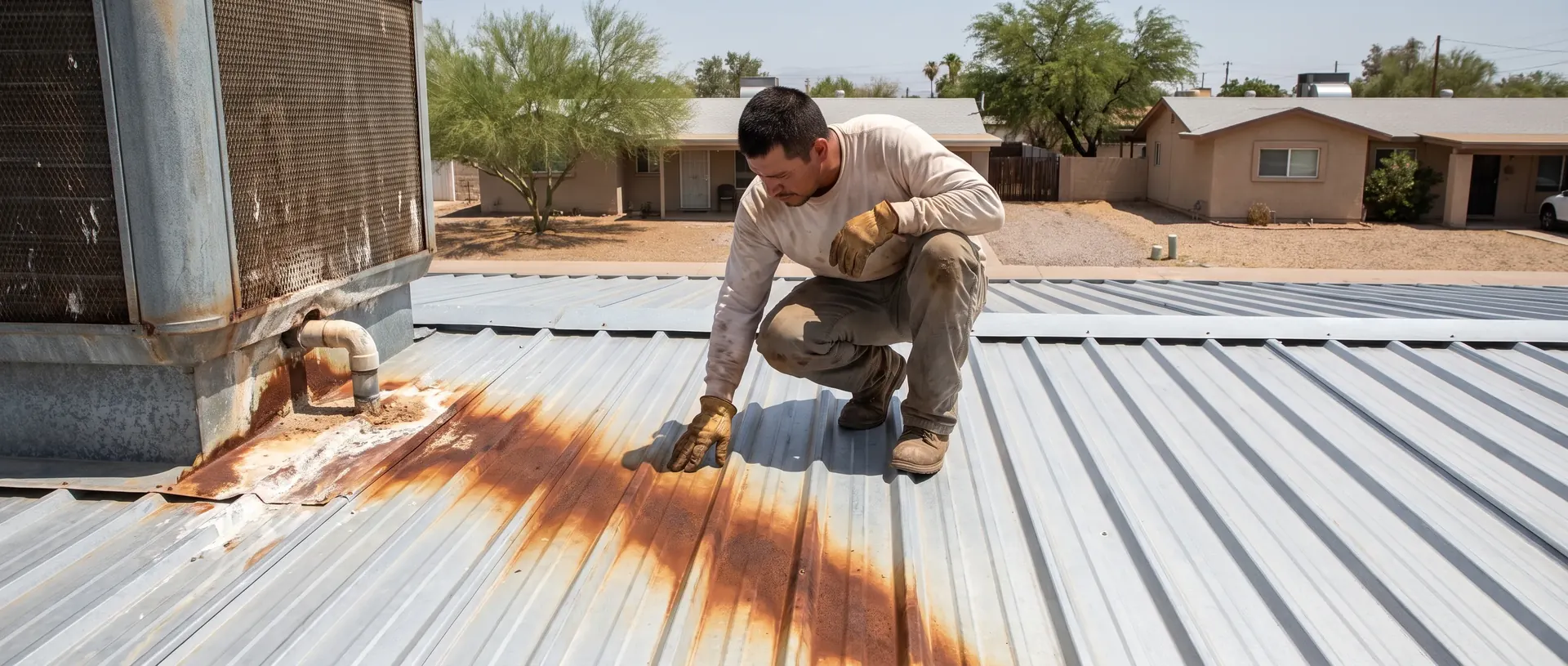
Phoenix is too dry to rust a roof. So when we find rust, we go looking for the water that caused it.
Find the source before treating the symptom
Rust and Corrosion Repair
Rust here is a symptom, not weather
In a wet climate, rust on a metal roof is just what happens. Rain, humidity and time do it, and the whole roof ages together fairly evenly. Metro Phoenix is not that climate. The air is dry for most of the year and the rain arrives in short violent bursts that are gone within the hour. A metal roof here has no business rusting from weather alone.
So when we find rust on a Valley roof, the interesting question is never how to treat it. It is where the water is coming from, because there is almost always a specific and findable source, and it is usually something somebody installed on the roof.
The most common by a distance is the evaporative cooler. A cooler works by running water over pads continuously while it operates, and it has to bleed some of that water off to stop mineral concentration building up. That bleed water, plus overflow when a float valve sticks, runs out onto the roof and takes the same path every single day through the hottest months. Follow a rust trail on a Valley roof uphill and there is very often a cooler at the top of it.
Air conditioning condensate does the same thing in a smaller way. So do improperly terminated drain lines, and so does anything that concentrates the little rain we do get into one narrow path. The practical consequence is important. Treating the rust without dealing with the water is a repair with a known expiry date.
What corrosion looks like at each stage
Surface rust
Discolouration and light scaling with the metal still sound underneath. This is entirely treatable and the panel stays. Caught here it is a small job and the roof loses nothing.
Deep pitting and pinholes
The corrosion has eaten into the thickness of the sheet and small perforations have started. This is the boundary. Some panels at this stage can be treated and sealed, and some are past it, and the difference is a judgement made with the panel in front of you.
Perforation and edge corrosion
Holes you can see through, or edges and cut ends that have corroded back. That section of panel is finished. Replacement is the honest answer and it is usually confined to a small area.
What we do when we come out
We trace the rust back to its source
Uphill, following the pattern. Rust that has a shape and a direction is telling you where the water came from, and that is the actual fault.
We check every water source on the roof
Evaporative cooler, condensate lines, drain terminations, anything that discharges onto the surface. This is where the fix usually is.
We assess how deep it has gone
The difference between surface rust and a panel that is perforating is the difference between treatment and replacement, and it needs looking at closely rather than from the ground.
We photograph everything
Each defect gets photographed where it sits. You get those pictures whether or not you have us do the work.
Process
How rust work goes
Find and fix the water
The cooler bleed line rerouted or terminated properly, the condensate line taken off the panel, the drainage corrected. Nothing else is worth doing until this is done.
Establish the extent
How far the corrosion has spread and how deep it goes, including under any overlapping panel where the water has been sitting unseen.
Remove the corrosion
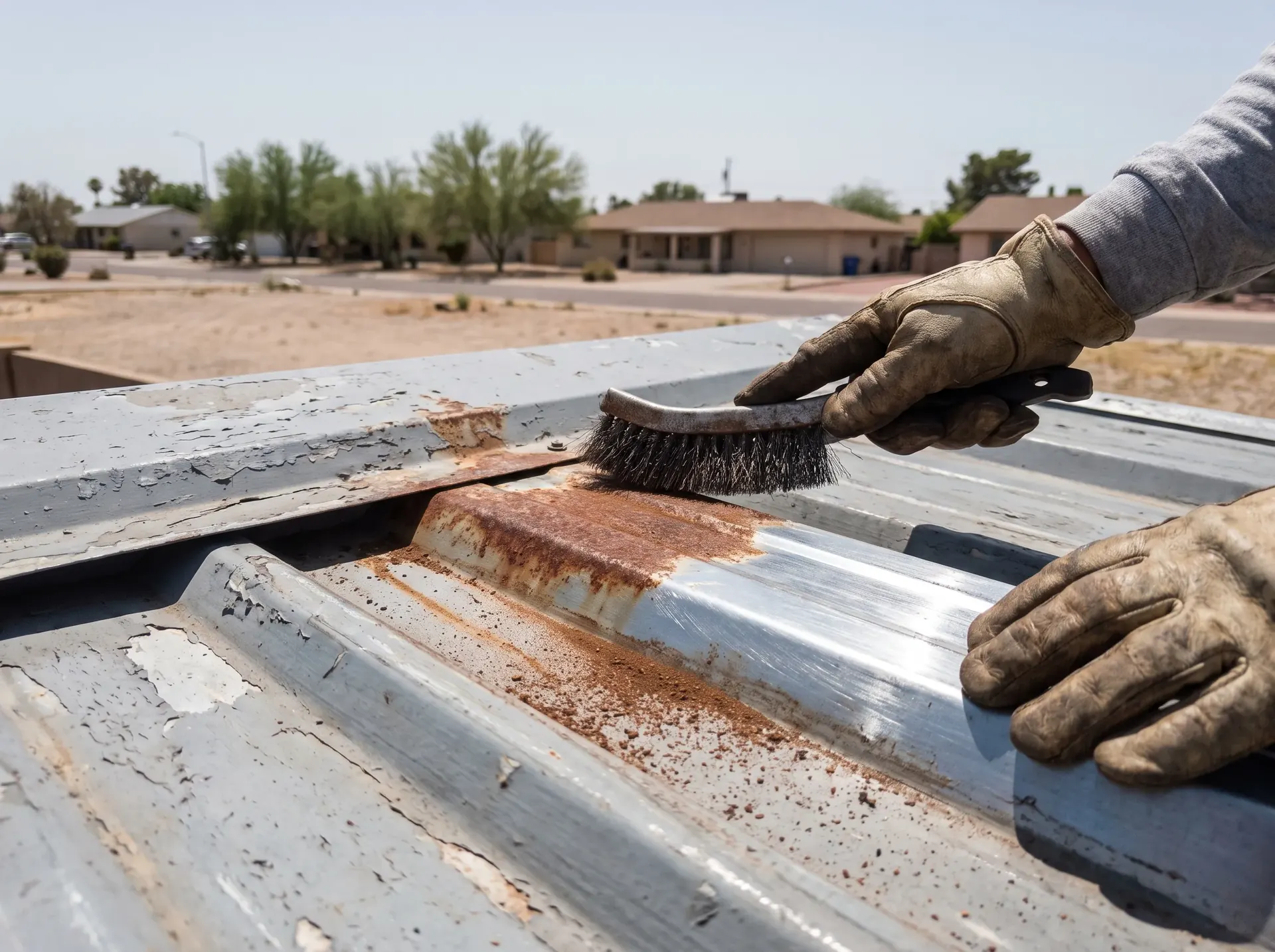
Wire brushing and mechanical removal back to sound metal. Rust left under a treatment or a coating keeps working.
Treat the prepared metal
An appropriate primer or converter on clean prepared steel. Applied to a surface that has not been properly prepared, none of these products do what they say.
Seal or replace
Sound treated panels get sealed and finished. Perforated sections get replaced, and that is generally a small area rather than the roof.
Check the whole roof for the same pattern
If one cooler has been doing this, the others usually have been too.
Why this goes better with us
We treat the cause, not the stain
Anyone can wire brush a rust patch and paint over it. If the cooler above it is still running water down the same path, that repair has one season in it.
We know the Valley pattern
Rust on a roof in this climate has a small number of likely explanations, and evaporative cooler discharge is at the top of the list. Knowing where to look saves a great deal of time and gets the real answer.
We are honest about the boundary
There is a real line between a panel that can be treated and one that is perforating, and it is tempting to treat something that is past it because that is the smaller quote. We will tell you which side of the line you are on.
We do not coat over corrosion
A coating over rusted through metal looks like a solved problem and is not one. Where a panel needs replacing, it gets replaced before anything goes over the top.
Rust streaks on your panels
If it has a direction, something above it is putting water there. That is worth finding.
Reviews
What our customers say
We have not collected any reviews yet. When we do they will appear here in full.
Common questions about rust on a metal roof
Can a rusted metal roof be repaired?
Usually, and more easily than people expect. Surface rust is removed and treated and the panel stays. Only where the metal has perforated does anything need replacing, and that is normally a limited area rather than the whole roof. The critical step either way is finding and stopping whatever was putting water there.
What is the best rust treatment for metal roofs?
Preparation matters more than product. Every rust converter and primer on the market assumes it is being applied to metal that has been cleaned back to a sound surface, and applied over loose scale none of them perform. Choose the treatment second and prepare the metal first.
Can rust on metal roofs be scraped off?
Loose scale can and should be removed mechanically, usually with a wire brush or an abrasive, back to sound metal. What scraping cannot do is reverse corrosion that has already eaten into the thickness of the sheet. Once the metal is thinned or perforated, removing the rust just reveals how much is gone.
How much does it cost to fix rust damage?
It depends on the area affected, how deep the corrosion goes, whether any panels need replacing and what has to be done to stop the water source. Correcting a cooler bleed line and treating a small patch is a modest job. Widespread pitting across several panels is not. We price it after looking.
Can rust be repaired permanently?
Treated corrosion on sound metal, with the water source removed, is a durable repair. What is not permanent is treating rust while leaving the cause in place, because the same conditions will reproduce the same result. The permanence comes from fixing the water, not from the product applied to the metal.
Will insurance cover rust damage?
Gradual corrosion is generally treated as wear and maintenance rather than sudden accidental damage, so it is commonly excluded. Damage caused by a specific sudden event may be viewed differently. We document what we find and what caused it, and the coverage question is between you and your insurer.
Get a quote
Tell us what the roof is doing
A photo showing the rust and whatever sits above it on the roof is the most useful thing you can send.
- Call
- (602) 555-0143
- Hours
- Mon to Sat, 6am to 5pm