Diagnosis
Rust on a metal roof in a dry climate: the evaporative cooler problem
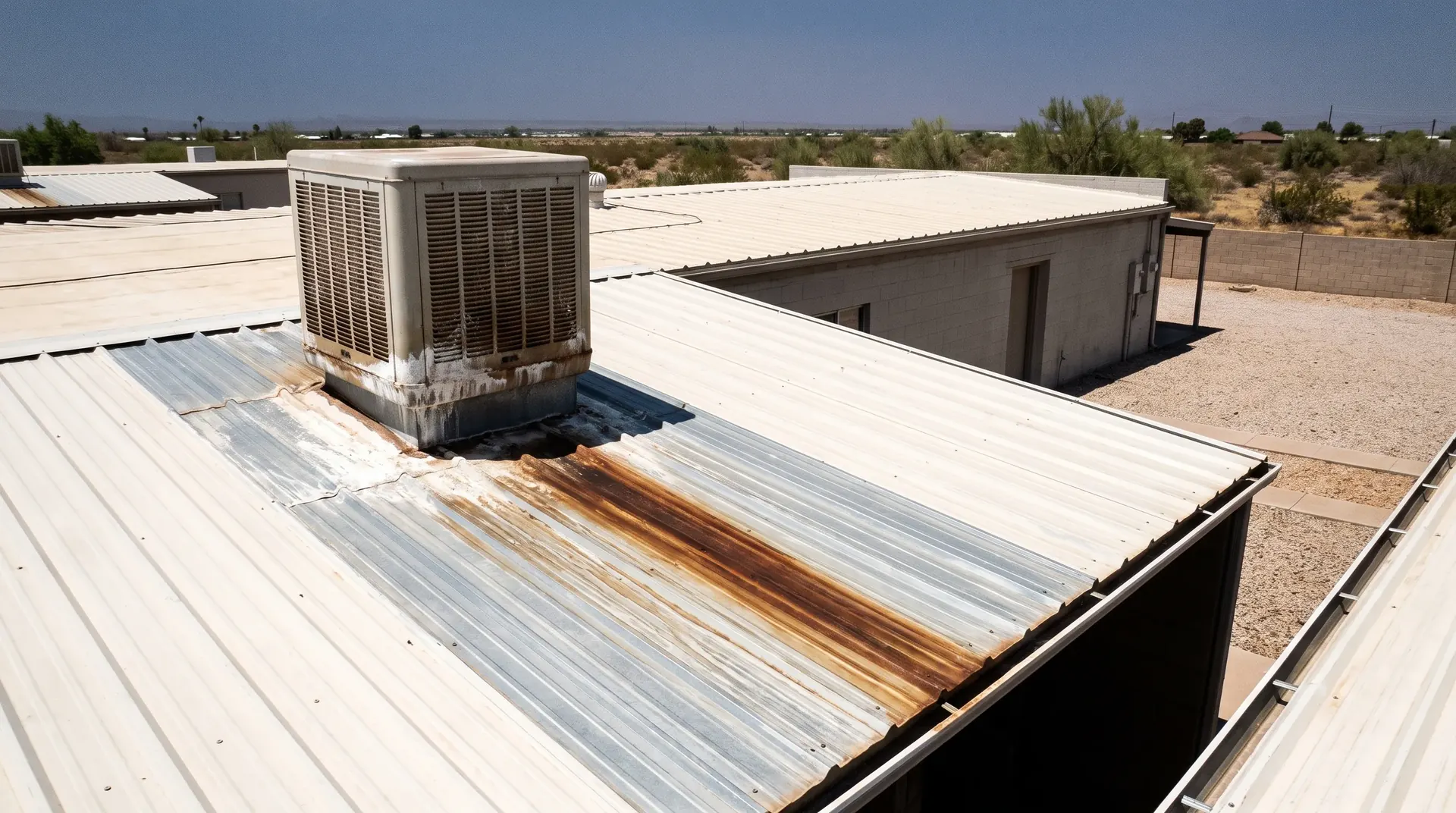
Metro Phoenix does not have the humidity or the rainfall to rust a metal roof. That is not an opinion about roofing, it is just what the climate is. So when we go up on a Valley roof and find rust, the interesting question is never how to treat it. It is where the water is coming from, because something is putting water there on purpose.
Nine times out of ten, it is the evaporative cooler.
Weather rust and source rust look completely different
Rust caused by weather is general. It appears across a whole roof plane at roughly the same rate, worse where water pools and at cut edges, but broadly even. That is what a metal roof does in a wet climate over decades.
Rust caused by a source on the roof is local and directional. It has a starting point, it has a width, and it runs downhill. It looks like a stain more than like ageing, and there is very often a clean, undamaged roof on either side of it.
In this climate, almost all the rust we find is the second kind. Once you know to read it that way, a rust trail becomes a map. Follow it uphill and you arrive at whatever has been putting water on that spot every day.
An evaporative cooler is a machine that puts water on your roof
That is not a criticism of the technology. It is how it works. Air is drawn through pads kept continuously wet, and evaporation off those pads is what does the cooling. Water is running the whole time the unit is on.
Two things follow from that.
First, a cooler has to bleed water off deliberately. Because it evaporates pure water and leaves everything dissolved in it behind, minerals concentrate in the reservoir until they destroy the pads and scale the unit. The bleed, or a purge cycle, dumps some of that mineral rich water to keep the concentration down. That water has to go somewhere, and on a very large number of Valley installations it simply runs out onto the roof.
Second, coolers overflow. A float valve sticks, a pad collapses, a line blocks, and now it is not a controlled trickle. It is a steady flow across the same section of panel.
Either way, the same square foot of metal is getting wet every single day through the hottest months, for years. That is more water contact than that piece of roof would get from Phoenix weather in a very long time indeed, and it is concentrated in one place.
The mineral content makes it worse
Bleed water is not clean water. It is deliberately the most mineral loaded water in the system, which is the entire reason it is being discharged. That accelerates corrosion beyond what the same volume of rainwater would do, and it leaves the white scale crust we often find at the top of a rust trail, which is a useful confirmation that we have found the source.
Air conditioning condensate does a smaller version
Refrigerated air conditioning produces condensate, and that has to drain too. A condensate line that terminates onto the roof surface rather than into a drain does the same thing on a smaller scale. So does any pipe somebody has left pointing at a panel.
Fix the water first, always
This is the part that gets skipped and it is the part that determines whether the repair lasts.
Wire brushing rust back to clean metal, treating it and sealing it is satisfying work and it looks finished. If the cooler above is still discharging onto that spot, the repair has a summer in it, maybe two. The metal is not corroding because it is bad metal. It is corroding because it is the only wet place on a dry roof.
Rerouting a bleed line so it discharges to a drain or off the roof rather than across it is usually a small piece of work. Re-terminating a condensate line is smaller still. Those are the changes that matter.
Then deal with the metal
Surface rust comes off mechanically, back to sound metal, and gets treated and sealed. Where corrosion has gone through the sheet, that section of panel needs replacing, and that is normally a limited area rather than the whole roof.
The boundary between those two is a judgement made with the panel in front of you, and it is worth being honest about, because treating something that is past it is the cheaper quote and the wrong answer.
Common questions
Can a rusted metal roof be repaired?
Usually. Surface rust is removed, treated and sealed, and the panel stays. Only perforated sections need replacing, and that is normally a small area. The essential step either way is stopping whatever put the water there.
What is the best rust treatment for metal roofs?
Preparation matters more than the product. Every converter and primer on the market assumes it is going onto metal cleaned back to a sound surface, and none of them perform over loose scale. Prepare the metal properly and the choice of treatment becomes a secondary question.
Can rust on metal roofs be scraped off?
Loose scale can and should be removed mechanically. What scraping cannot do is restore metal that has already been eaten into. Once the sheet is thinned or perforated, removing the rust simply shows you how much has gone.
Should I move my evaporative cooler off the roof?
That is a question for a cooling contractor, and there are good reasons people keep them where they are. What can be done is making sure the water it produces is not running across your roof, which is usually a straightforward change to where the bleed line discharges and much cheaper than repeatedly repairing the rust.