Service
Seam and flashing repair
Panels are simple. Everywhere two of them meet, or one meets a wall, is where the work is.
Opened, cleaned and rebedded, not smeared over
Seam and Flashing Repair
The joints do the hard work
A flat sheet of metal in the middle of a roof has almost nothing to do. It sheds water and it sits there. Every difficult thing a roof has to manage happens at an edge or a junction: where one panel laps another, where the roof turns a corner, where it runs into a wall, where it stops at the ridge.
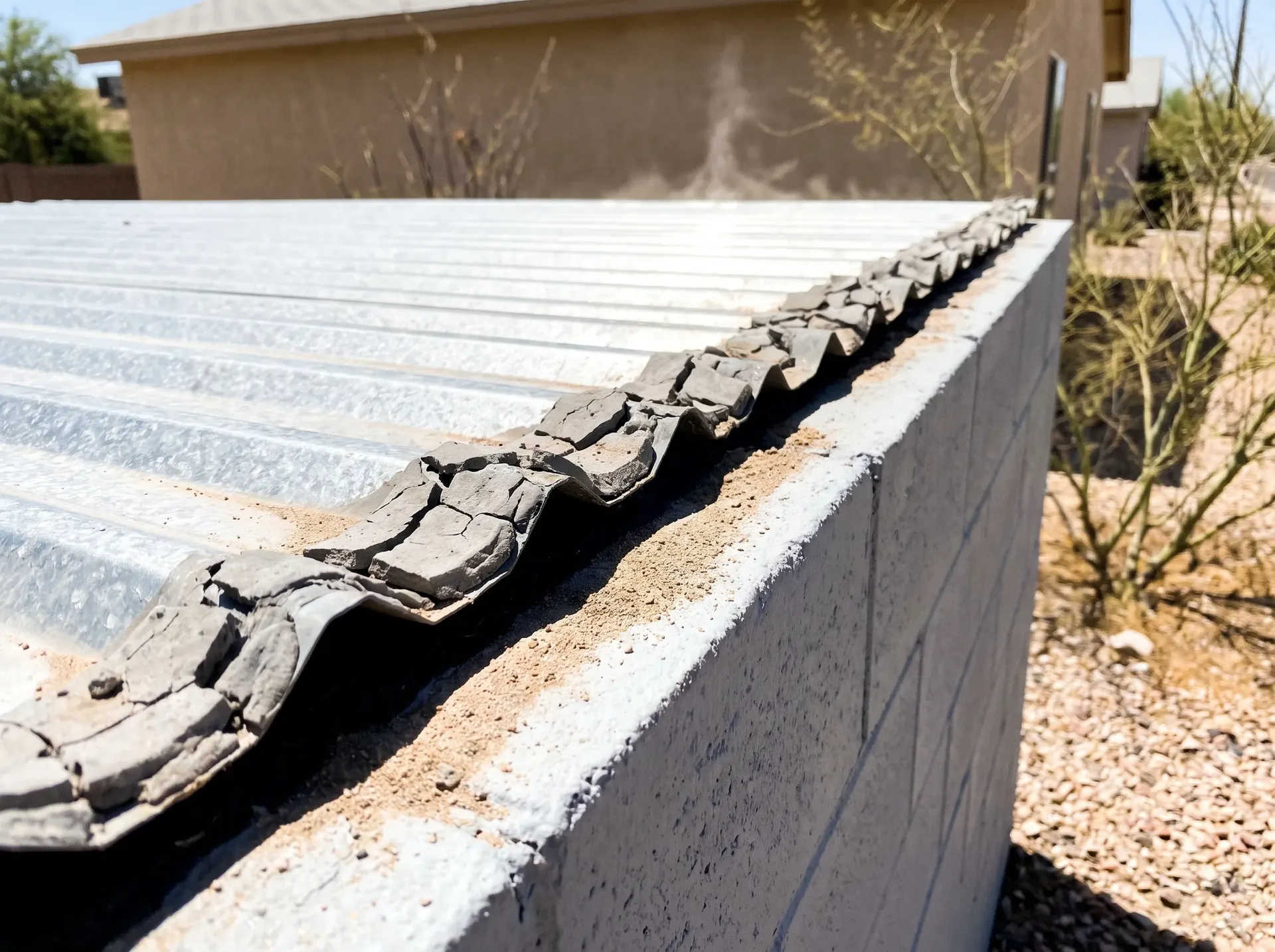
Those junctions are held together by a combination of overlap, fastening and sealant, and in metro Phoenix the sealant is the part on a clock. Butyl tape and roof grade sealants are engineered products with a real service life, but that life is set by ultraviolet exposure and heat cycling, and this is close to the worst environment in the country for both. Material that would sit happily for fifteen years somewhere temperate can be hard, shrunken and pulling away from the metal in a fraction of that time here.
The failure is quiet. Sealant does not fall off dramatically. It shrinks, goes rigid, cracks into segments and lifts a millimetre away from the surface, and the roof carries on looking perfectly fine from the ground. Then the first serious monsoon drives rain at it sideways and the gap that has been opening for two years finally gets used.
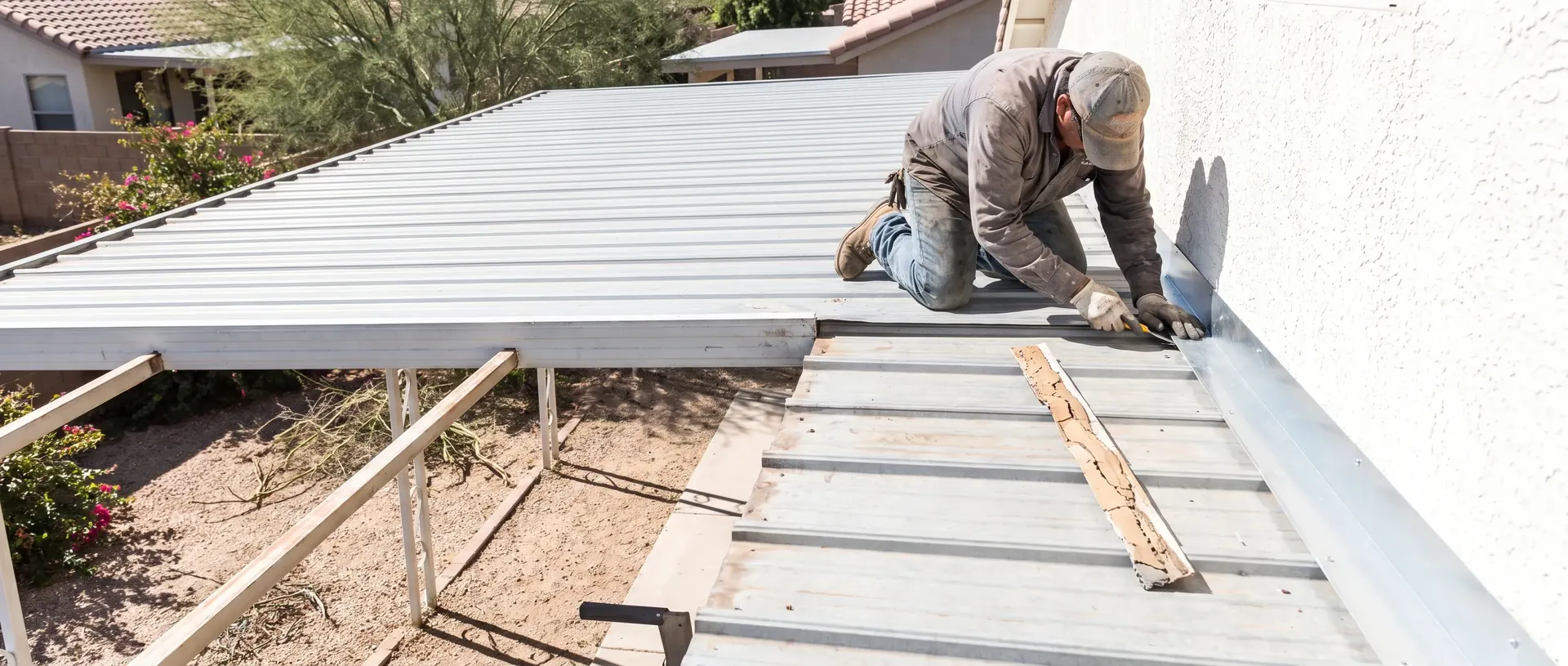
There is a particular version of this we see constantly across the Valley: the point where an added patio cover, carport or Arizona room meets the wall of the original house. Those additions were usually built later, by somebody else, and flashed into the wall with more optimism than technique.
Where the joints give way
Side laps and end laps
Where panels overlap each other. End laps are the worse of the two, because water has to be persuaded to keep running downhill across a joint, and wind can push it back up. When the sealant in the lap hardens, that persuasion stops working.
Ridge, hip and rake trim
The pieces that cap the top and close the edges. They take the most wind load of anything on the roof, they are fastened through into the panels below, and they are usually the first component to move in a microburst.
Wall transitions and headwall flashing
Where a roof plane dies into a vertical wall, most often on a patio cover or an addition. Done properly the flashing turns up behind the wall finish. Done the cheap way it is stuck to the face of the stucco with sealant, and that joint has a short and unhappy life in this climate.
What we do when we come out
We go over every joint on the roof
Laps, ridge, hips, rakes, valleys, headwalls, sidewalls and every transition. Joints fail in similar conditions at similar rates, so where one has gone the others are worth checking.
We work out how it was originally detailed
Whether the flashing was let into the wall properly or surface stuck makes an enormous difference to what the repair involves, and it is not always visible until we get close.
We check what the water has already reached
An open headwall joint has usually been wetting the wall and the framing behind it for longer than anyone realises.
We photograph everything
Each defect gets photographed where it sits. You get those pictures whether or not you have us do the work.
Process
How a seam repair goes
Find every open joint
Not only the one above the leak. Sealant across a roof is usually all the same age and has usually had the same summers.
Open the joint up
Fasteners released so the lap or the flashing leg can be lifted. This is the step that gets skipped, and skipping it is why so many previous repairs are sitting there as a bead of caulk on top of a joint that is still open underneath.
Clean out the old material
Hardened sealant and old tape removed back to clean metal. New material will not bond to the remains of the old, and dust in this climate gets into everything.
Rebed the joint
Fresh butyl or sealant in the lap, in the right place and the right quantity, then the joint closed back down onto it so the material is compressed rather than exposed.
Refasten
New fasteners through the joint, since the old holes have been disturbed and the old screws have already had their life.
Water test
Water run at the repaired joint, including at an angle where wind driven rain is the suspected cause, and checked from underneath where there is access.
Why this goes better with us
We open joints instead of coating them
A bead of sealant run along the outside of a failed lap is the most common bad repair in the Valley. It looks like work, it sheds water for a season, and it traps the actual defect underneath where it carries on quietly.
We choose material for this climate
There is a large difference between a sealant that survives an Arizona roof surface and one that is dust in three summers. That choice is most of the job.
We know the patio cover problem
The junction where a later addition meets the original house is the single most common flashing failure we see here. We know how these were built, why they leak, and what can realistically be done about one without demolishing the wall.
You keep the evidence
Photographs of every joint we opened and what was inside it. That is the only way to know whether a repair was done or merely covered.
Leaks only when the wind blows
That pattern points straight at a joint rather than a hole. It is worth looking at before monsoon season rather than during it.
Reviews
What our customers say
We have not collected any reviews yet. When we do they will appear here in full.
Common questions about seams and flashing
How much does it cost to have flashing repair on your roof?
It turns on how the flashing was originally installed, how much of it has failed, and whether the wall or framing behind it has been damaged. Reworking a surface stuck patio cover joint is a different job from redressing a properly let in headwall. We look before we quote.
How long will flex tape last on a roof?
Consumer tapes are a way to stop water for a few days until somebody can do the repair, and in this climate they degrade quickly under direct sun and daily heat cycling. They are genuinely useful in an emergency during monsoon season. They are not a repair, and a joint taped over is a joint nobody has opened.
What is the longest lasting roof sealant?
The honest answer is that the product matters less than where it is placed. Sealant compressed inside a closed lap, shielded from ultraviolet, lasts a very long time. The same material run along the outside of that lap and left in the sun has a short life here regardless of what it cost. Detail beats product.
What is the best waterproof tape for roof leaks?
For a genuine repair, none of them, because the correct fix is to open the joint and rebed it. For getting through a storm at night with water coming in, a butyl backed flashing tape on a clean dry surface will usually hold long enough. Treat it as buying time.
Where do most metal roofs leak?
Fasteners first, then end laps, then penetrations, then wall transitions. That ordering holds well across the Valley. Seams and flashing account for a very large share of what is left once the fasteners have been dealt with, and they are the usual answer when a roof only leaks in wind driven rain.
Why does my roof leak sometimes and not others?
Because the defect is a joint rather than a hole. An open lap or a lifted piece of trim will shed ordinary vertical rain perfectly well, and only lets water in when wind drives it at the roof from the right angle with enough force to push it uphill. That is exactly what a monsoon does.
Get a quote
Tell us what the roof is doing
Tell us whether it leaks in any rain or only when the wind is behind it. That one detail narrows it right down.
- Call
- (602) 555-0143
- Hours
- Mon to Sat, 6am to 5pm